This new short-HomePage contains key ideas from the original long-HomePage of my large website about Education for Problem Solving. I want to show you how Design Process (it's my model for Problem-Solving Process) might be very useful in education, so its possibilities are worth exploring and developing, because (although not proved with certainty) this is “a good way to bet.”
iou – In my philosophy of writing an essential goal is to explain clearly – and doing that usually is easier with more words – so this “short HomePage” has become longer than I originally intended.
This HomePage has two parts:
Part 1 describes educational goals that are generally accepted, that you (as an experienced educator) already know and probably accept, so while reading you'll be thinking “yes”. But I also explain how using Design Process can help us achieve our goals, and for these claims you might think “yes!” or “yes and...” (yes plus adding your own ideas) or “yes but...” (with questions) or “maybe” or “no because...” (with reasons to reject), and all of these responses can be useful when we're working to co-create better education.
Part 2 is about my model for Design Process (for Problem-Solving Process) that is descriptively accurate and educationally beneficial, that – especially when it's effectively combined with other models – can help us achieve the worthy educational goals in Part 1.
How? The best way to understand Design Process is to learn by discovery (and recognition) when you study – by observing the words & colors, and spatial relationships – three verbal-and-visual representations in a special Discovery Page. Then you can explore useful details in that page & this page, and elsewhere.
my model for Design Process
(for Problem-Solving Process)
These sections supplement the Discovery Page that has four main parts:
• an Introduction (explaining “how to learn by discovering”) plus the 3 main diagrams (with “ 1+ 2 = 3”),
• flexible goal-directed improvising and three common Action Sequences (two Quality Checks and a Reality Check),
• two wide scopes for a wide variety of Activities, and for similar (but not identical) Process,
• three shorter sections — about easier learning (with simple steps and logical organization) & three questions about a mystery & how my favorite diagram blends art with logic, integrates Design with Science — plus a collection of short sections to explain important details: ====
iou – September 14-17, I'll revise the ideas in this "gray box" and will move them elsewhere.
The Discovery Page says very little about B2, so here is a little more information: BOTTOM PART OF DIAGRAM 1 [[ just link to home.htm ? ]] defining a New Problem: Usually you will view B2 (Choosing-and-Actualizing a Solution as being a continuation of your original Old Problem. But B2 might be different enough that you'll want to think of it as a New Problem that overlaps with the Old Problem yet is different, with its own distinctive new challenges. If you do this, you again will do Stages A (Learn, Define & Define) and B1 (Generate Options & Evaluate Options) and B2 (Choose A New Solution & Actualize This New Solution).
basic DP (cut or incorporate into "three Action Sequences")Quality Checks (during Design) and Reality Checks (for Science): This diagram shows how people typically Evaluate An Option by imagining The Option {in a Mental Experiment} or actualizing The Option {in a Physical Experiment} so you can make {PREDICTIONS} or {OBSERVATIONS} about The Actual Properties of This Option. By contrast, your GOALS define the Desired Properties you want in a New Product that will be your Problem-Solution. Why is each of these comparisons a QUALITY CHECK? { You also can think about why a comparison of PREDICTIONS with OBSERVATIONS is a REALITY CHECK that helps you test the adequacy of an explanatory Theory. } |
the wide scope of our Problem-Solving Process
and the descriptive accuracy of Design Process:
The introduction for Two Wide Scopes makes a bold claim: "Most people use a Problem-Solving Process that is similar (but not identical) for almost everything we do, AND this intuitively-natural process is accurately described by my model for Design Process (for Problem-Solving Process)."
To see the similar process and descriptive accuracy, compare The Actions of Design Process — first in Diagrams 1-3 and then in three Action Sequences — with Your Actions in your memories of how you solve problems. Probably you will think “These Problem-Solving Actions (in Design Process) are My Problem-Solving Actions (in My Life)” so your Discovery Learning becomes Recognition Learning. This recognition will happen for you and for others, due to the similarity-of-process in general human problem solving, and because...
Design Process accurately describes Our Process: A model for problem solving should accurately describe the process that people actually do use (intuitively & naturally, and also with conscious intention) while we are solving problems. Design Process is basically (although not completely) an accurate description for...
conscious-and-subconscious problem solving: Our amazing whole-brain system combines conscious cognition with subconscious processing. I'll briefly summarize the basics here, and will add details elsewhere. But AFAIK – based on what I now know – the typical operating of our whole-brain system (including our subconscious processing) is also (like our sub-system of conscious cognition) described accurately with Design Process. / I also will explain why "basically" isn't "completely" because it's simplistic (but in ways that are useful for education) compared with the actual super-complexity that occurs in our conscious or subconscious, and in their combination.
some educational benefits of descriptive accuracy:
When students get Problem-Solving Experiences and then Reflect on their Experiences, they will observe themselves doing the Actions of Design Process, and this recognition helps them use a Process-of-Inquiry to discover Principles-of-Inquiry, with Experiences + Reflections ➞ Principles. This is one way to help students learn more from their problem-solving experiences by developing-and-using Strategies for Thinking. They will gain many kinds of benefits, because Design Process can be used for cognition-and-metacognition that will improve the problem solving & self-regulating they use in school and in other areas of life.
some educational benefits of the two wide scopes:
The two wide scopes (for PS-Activities & PS-Process) are educationally useful because these — along with the logical organization of Design Process (including its logical integrating of General Design with Science-Design) — let us show students how Design Process promotes transfers-of-learning (across areas & through time), and this can motivate students so they will want to pursue their own personal education when they build bridges from school into life so they get direct benefits by improving their abilities (to learn & perform) plus indirect benefits by improving important attitudes, in their motivations (for wanting to learn) and their confidence (in being able to learn, with a growth mindset). The wide scope of PS-Activities gives teachers the option of choosing to use Design Process (or not use it) for most of what they do in the classroom, with options ranging from improving basic skills-for-learning to creatively designing a wide variety of fun-and-useful activities.
put section into right fram
We can use Design Process to help students
develop-and-apply Thinking Strategies for
metacognitive Self-Regulated Learning:
This is one of the most educationally beneficial ways we can use Design Process.
why? Based on abundant research, we know that metacognition is highly effective for helping students improve their academic skills (in many ways, including scores on standardized exams) and social-emotional skills.
what? Two effective strategies are metacognitive self-questioning and (especially) metacognitive Self-Regulated Learning; combining these is much more effective than either by itself. { You can see an overview of research results° in a report from Perplexity AI. }
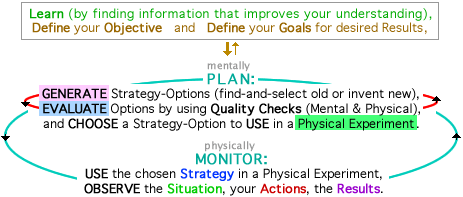 how? { iou – November 6-7, this section will be revised. } Compared with the simplicity of basic self-questioning, it's more difficult to teach Cycles of Self-Regulated Learning (SRL), but... it will be easier-and-better (for teachers & students) when we use Design Process, because a Cycle of SRL is very similar to a Cycle of DP, as you see in this version of Diagram 1 that is modified for teaching SRL-with-DP so the diagram is DP-for-SRL.
how? The skills of metacognitive Self-Regulated Learning are usually taught as a Cycle of SRL with three parts, commonly called “Plan, Do, Reflect” or “Forethought, Performance, Evaluation”. This diagram is the top of Diagram 1 (thus also 3) with the Cycle modified by labeling its main parts “Plan, Do (and Monitor), Evaluate” to match the common terms in SRL, with other parts labeled to match the terms in DP. This diagram also adds details that are important for metacognition that is guided by SRL.
why: When you teach SRL with DP, it's easier-and-better (for teachers & students) in three ways. • First, it's easier because you almost “get two for the time-cost of one” due to the low “marginal cost” – it isn't free, but is almost free – of the extra times required (for preparation and in the classroom) to teach-and-learn SRL, after the teaching-and-learning of DP. • It's better because teaching SRL-with-DP is “SRL Plus” – it's SRL plus “added value” – because DP can be used for “doing SRL” (it's SRL-with-DP) and also for doing a much wider range of “making things better” in all areas of life, because DP is a model for doing the cognition-and-metacognition that people use for Problem Solving and Self-Regulated Learning. • It also is better because learning SRL-with-DP will help students develop a deeper understanding of metacognitive SR and better skills when using SRL, with increased transfers-of-skills because the two broad scopes of DP also will broaden the two scopes of SRL.
All of these ideas (and others) are examined more deeply in the HomePage. { plus ideas about developing-and-using mental maps }
Consistent with the “discovery learning” goals in this page, I'll ask some questions to guide your exploring so you can Learn by Discovery. In the DP- for-SRL Diagram that's used to teach SRL with DP, think about the...
meanings & objectives for colors: What are the symbolic meanings of the color-codings for blue and green? i.e. What is the “mode of action” for all blue Actions, and for all green Actions? And what is the purpose (the Objective) of the blue Actions, and the green Actions? / Also think about “what and why” for the other colors, for the purple, red, and brown.
experiments and cycles: Why are there multiple Mental Experiments in the Mini-Cycle (to Generate-and-Evaluate by using Predictions-Based Quality Checks), but only a single Physical Experiment in the Overall Cycle (to Generate-and-Evaluate, using an Observations-Based Quality Check)? And which two terms can occur due to Reality Checks during the Physical Experiment?
Although you probably don't need it, these questions are “answered” with my explanations, along with other comments about SRL-with-DP.
combining models-for-process: [[ iou – during late February, here I'll briefly describe how Design Process can be combined with other models-for-process, in direct applications (like using DP during POE) and indirect applications like supplementing the concepts of Design Process with the concepts of d.school (emphasizing the values of empathy and of developing & using "mindsets" that make your PS-Actions more effective). ]]
iou – i'll fix these three paragraphs before tomorrow, January 27:
what? With educationally-useful broad definitions, a problem is an opportunity to make things better in any area of life, and problem solving happens when we do make something better. / Yes, my broad definition of problem solving (as "whenever we make something better" differs from a common perception that a problem always begins with “a bad situation” because with my definition your feelings about the current now-situation could range from dismal thru lukewarm and wonderful to awesome. If your actions produce a “move toward a better place” anywhere within the wide range — whether it's a change from dismal to lukewarm, or from wonderful to awesomely spectacular — it's problem solving because the situation has become better. { This also leads to a broad definition for the designing that is problem solving – because I treat them as synonyms (in most ways) – e.g. when I say Design Process is Problem Solving Process, and describe the "what?" below, and throughout the website. }
why? People solve problems because we want to make things better. Or we want to avoid letting things get worse, because we can make things better by increasing quality or maintaining quality, by either promoting a helpful change or resisting a harmful change.
using broad definitions: [[ iou – during late February, I'll develop-and-revise this paragraph so it's a better description of the broad definitions that I use for Design Process. Why? Because the broad generality is beneficial by making the two scopes be wide, and in other ways. But... this broad-ness (a benefit in some ways) differs from the narrow-ness of definitions that are more precise (a benefit in other ways), but... we can use this tension to promote productive student thinking about one aspect of empathy-based communication when we ask “what exactly do you mean? what are your definitions?” in an effort to understand more accurately & thoroughly, and respectful communication when students recognize that different views can offer different benefits, so although "being different" can be due to "being wrong" this usually isn't the reason for differences. / We'll look at the educational utility of choosing to use broad definitions for problem and problem solving & designing (as above) and for education – experiments – theory & model – science – and maybe more. ]]