Greetings,
This page has three parts ( • • • ); two are described at the beginning and ending of my 3-Page Description in a proposal for OAGC 2026.
• the beginning: "Here I'll describe the main features of my talk, but you will get a much better understanding by using the information in an ‘OAGC Page’ [it's this page] because you'll SEE my model for Design Process (for the Design-Thinking Process that is Problem-Solving Process)." { see my model }
• the ending: I refer to personal reflections on my talk for OAGC in 2025, when afterward I asked “why did I not do it better?” and (more important) “how can I learn, so I will do it better for future conferences?” { my answers: how learning from 2025-Experience will improve 2026-Quality }
• also: my OAGC Bio
There will be two stages for this page:
Now it's written for you – the reviewers for OAGC – to provide information that will be useful when you are thinking about the talk.
Later it will be written for potential talk-participants, to provide information that will be useful when they are thinking about the talk.
You will get a much better understanding [when you] SEE my model for Design Process, and you...
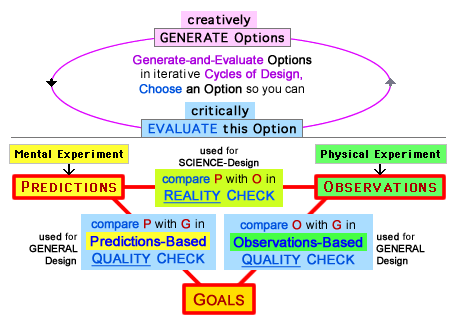 learn from Your Discoveries and My Explanations: This is the best way to understand my model for Design Process (for Design-Thinking Process that is Problem-Solving Process). You can begin your “discovery learning” by studying this diagram, which is a verbal-and-visual representation of how you combine your Problem-Solving Actions to form your Problem-Solving Process.
You can discover more thoroughly by using Part 1 of the HomePage. It guides your explorations when you study this verbal-and-visual representation by observing (and thinking about) the words & colors and spatial relationships that will help you find the logical structures that show Two Essential Actions. It also asks a Mystery Question — “Why does the Cycle have a right-side arrow, pointing from Evaluate to Generate?” — and this “why” makes it a Third Essential Action. / Then you can compare Your Discoveries with My Explanations – and supplement your Discovery Learning with Recognition Learning – at the end of Part 1.
also: A time-efficient way to learn more about this model (in Part 1) and its educational benefits (in Part 2) is to use a special Mini-Page that helps you learn on three levels, with a Brief Overview (to quickly get a “big-picture overview”) and an Expanded Overview (with a little more explanation) that (so you can develop deeper understandings) has links to sections in the HomePage of my website about Education for Problem Solving. But the final versions of these two Overviews are not yet finished, so temporarily the Mini-Page also includes earlier versions of the two Overviews, in a Short Description and Longer Description.
And one valuable teaching strategy – motivating with Adventures – is especially useful for gifted students.
This part of the page will be...
• an explanation of “what happened with my talk for the 2025 OAGC Fall Conference, and why.”
• my apology for making a large withdrawal from my Emotional Bank Account (a concept from The 7 Habits) in 2025 when you trusted me and I let you down, plus my hope that in 2026 you will graciously give me an opportunity to make a large deposit.
• my Five-Part Plan for doing an excellent talk in October 2026.
in 2025, what happened and why:
I've done many talks, and most were fairly good, as in a 2022 seminar (for OSU Engineering Education) when I was able to honestly tell friends, by email, that "I was lively and logical, they added valuable insights, we had fun." But the most valuable lessons began recently after a talk-failure in October 2025, because I'm using it as a learning experience so I will “do it better” in future talks. Here is the beginning of my story in the OAGC-2025 Page:
After the conference, my initial response was mild despair because I had A Big Opportunity and I failed. This didn't feel good, it wasn't fun. But the next day I decided to have a different response, with a resilient determination to do goal-directed actions that will be productive, because I'm confident that my ideas will be educationally beneficial so I want to continue sharing them. .....
Why did I fail? As in the past when I made a mistake and asked “why?” — to use my failure as feedback that will help me learn from the experience (for self-education) so I can “do it better” the next time — again my answer included “ineffective process” because in some parts of my Problem-Solving Process I was not effective in doing essential Problem-Solving Actions. For this talk the two main mistake-causes (in the “Process Actions” I didn't do) were by not frequently asking (and wisely answering) the time-question, “what's the best use of my time?” and by not making two PowerPoints, i.e. I didn't convert my initial long Overview-PowerPoint into a shorter Talk-PowerPoint.
What is my plan? ..... Motivated by personal goals and a growth mindset, I'll do Learning that improves Performing – by trying to “do my best possible learning now, to help me improve my best possible performing later” – with a current Learning Goal that will help me achieve a future Performing Goal.
our Emotional Bank Accounts (in the past and present )
in 2025, our past : I sincerely apologize for making a large withdrawal from my Emotional Bank Account with you. You trusted me and I let you down, unintentionally but actually. I promised that “I can do this” in April, but in October I didn't do it well.
in 2026, our present : I'm hoping you will graciously give me an opportunity to make a large deposit, because if I can do another talk I'm confident that it will have high quality – with useful ideas that will help other educators – so it will be a win-win for all of us.
in 2026, my Five-Part Plan:
My OAGC Page describes "a resilient determination to do goal-directed actions that will be productive." How? Here are five phases (with overlap) in my process of preparing for future talks. I will...
1) develop my plans for the talk, summarized in its proposal (Title & Short Description, and 3-Page Description) plus this OAGC Page. (in a "Stage 2" that's revised so it's useful for potential attendees)
2) revise my website – especially its HomePage and Mini-Page – about Education for Problem Solving, because this will help readers develop understandings (of my model and its educational usefulness) on three levels.
3) revise an Overview-PowerPoint so it also will provide a “big picture overview” that is becoming more effective. Its content will be similar to the Two Pages (HomePage-plus-ModelsPage) but it will have a different style, a different verbal-and-visual feeling. It will explain ideas in fewer words (so viewers will have to “fill some gaps”) but it might be quicker for them overall. Or maybe a reader will prefer the website's Two Pages, and both options will be available for them.
4) make a Talk-PowerPoint by modifying the Overview-PowerPoint. Why? Because in the Overview-PPt most slides will have Too Much Information to be useful during a talk. Instead I'll make a shorter Talk-PowerPoint with Just Enough Information to be useful during a talk. It will have fewer slides and less average information-per-slide, because it's designed (with careful planning & editing) to form a framework that will help me make the main ideas (and some discussion)* “fit into” the available time.
5) do multiple rehearsals of the talk — mostly alone, but hopefully also for people who want to be an “audience” so they can learn the ideas, and can help me by giving feedback about the talk – so I can make adjustments, to be sure its content (main ideas + discussion) will “fit into” the available time. And I'll use online resources (videos, web-pages, AI) to learn principles & strategies for designing-and-doing a better talk, by making a better PowerPoint and in other ways.
* the 3-Page Description describes three of the ways my talk will be interactive:
Talk-participants will see my model when they enter the room and we will "begin before the beginning" with an on-screen slide showing the model and inviting them to study its words & colors & spatial relationships, to search for Two Essential Actions and answer a Mystery Question that is a Third Essential Action. I'll walk among them, asking "what are the Essential Actions?" and "are you solving The Mystery?" to establish a feeling that "this will be informative and fun." At the official starting time, I will ask the questions and they will share what they've discovered, and their thoughts on The Mystery. Then I'll quickly explain WHAT the model is, HOW teachers can use it, and WHY it offers educational benefits.
Early in the talk, I'll ask participants "what do you think about my claims for a wide scope?" after I support this claim [with a characteristic of Design Process plus] my broad definition of Problem – it's an opportunity to Make Something Better, in any area of life – so Problem Solving includes most things we do. You are Problem Solving (verb) whenever you are trying to Make Something Better by Designing a Solution for a Problem, and you are a Problem Solver (noun) when you do Make Something Better. And I'll propose categories for Problem-Solving Goals if we choose to design a better product, activity, relationship, and/or strategy (in General Design) or (with Science-Design) a better theory about "how things work in the world." The discussion questions will be "what do you think about my claim for a wide scope that includes most things we do?" and "would other ways-to-categorize help students more easily recognize their own Problem-Solving Goals, and thus be more useful for helping them understand the wide scope?"
Later in the talk, I'll ask "can teachers effectively teach metacognitive strategies with reasonable investments of preparation-time and classroom-time?" And some POV-Questions, "Will students and teachers & administrators respond differently, re: time investments and excitement about adventures in thinking (generally) and (specifically) using models & metacognition?" and "How will this be affected by a program's emphasis on acceleration and/or enrichment?" "What are some potential problems with implementation, and strategies for designing & actualizing problem-solutions?"
Here is my OAGC-Bio:
I'm an enthusiastic educator (with a PhD in C&I from U of WI) who wants to find co-enthusiasts so we can discuss my ideas & your ideas, and your goals. I'm especially excited about helping students improve their skills in problem-solving Design Thinking, and I've developed a comprehensive website about Education for Problem Solving. Although it's based on solid principles of learning and offers productive strategies for teaching, I don't have any direct experience with teaching K-12, so I need help from fellow educators who have better understandings of K-12 students, teachers, and culture. {for more, EducationForProblemSolving.net/oagc}
I've taught chemistry (as instructor for UW-Madison) and physics , math , ESL – plus the skills of tennis , juggling , ballroom dancing , music improvising – and have enjoyed all.
I have degrees in Chemistry and History of Science, plus Curriculum & Instruction that is my favorite, is the central hub (with many fascinating spokes) for continuing adventures in lifelong learning. It's a strong motivation for action, because improving our education — by designing better ways to teach & learn, so we can improve our thinking and doing — is one of the most important things we can do. And it's fun!
contact-email: craigru57-att-yahoo-daut-caum